


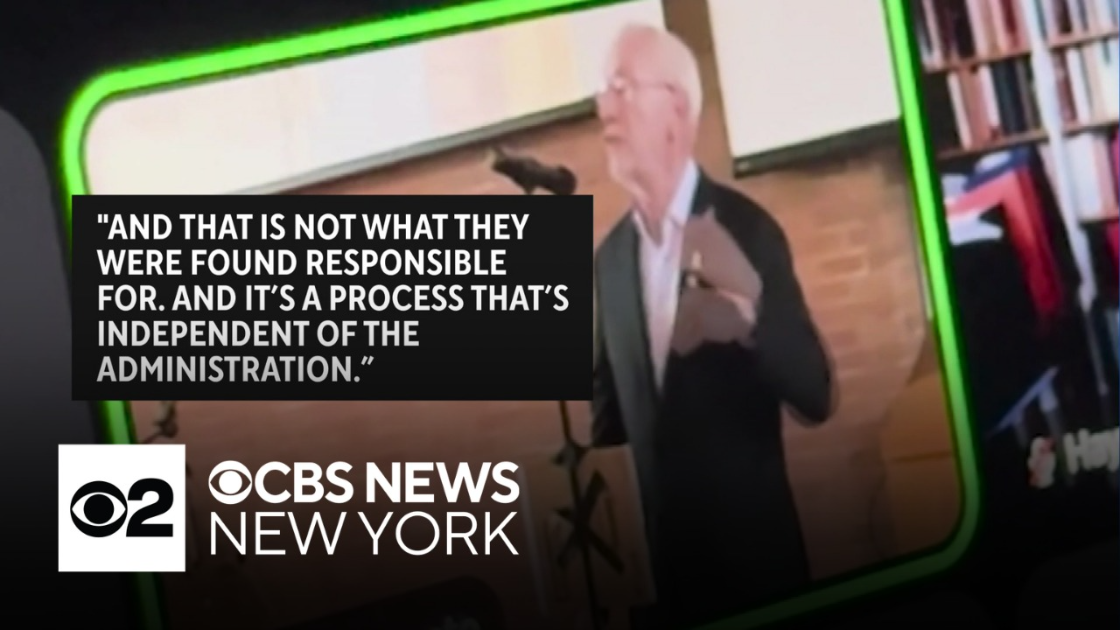
▶ Watch Video: See it: Insight into Cornell University Faculty Senate meeting
Exclusive video offers insight into Wednesday’s high-stakes meeting at Cornell University.
The school’s president, Michael Kotlikoff, faced questions from faculty Wednesday over the handling of sexual assault allegations as it considered a resolution of no confidence in the school’s administration.
This comes nearly two years after a student identified only as Jane Doe reported to campus police being gang-raped at a fraternity house. Earlier this month, the university announced former Deputy U.S. Attorney General Sally Yates will lead what they call a “comprehensive independent review” of its handling of sexual misconduct claims, including the 2024 case.
Kotlikoff discussed the possibility of banning fraternities altogether at Cornell. He told the gathered faculty that he had just attended a town hall with alumni who had told him how important their fraternity and sorority experience was to them.
Kotlikoff said the issue should be studied.
“If at the end of the day fraternities can not exist in a safe environment, and we can’t be convinced that they can be safe, then we should make that decision. But we should make it, it seems to me, based on data, and study, and expertise,” Kotlikoff said.
Additionally, on Tuesday, Kotlikoff announced sweeping changes, saying Cornell will work with New York State Police on an arrangement to bring in independent experts to investigate sexual assault allegations. The school has also banned fraternity parties for the rest of the academic year.
At Wednesday’s meeting, faculty debated whether they have confidence in the university’s leadership handling of sexual assaults.
The meeting was closed to reporters and the university said no cameras were allowed on the grounds that it would inhibit the debate, but CBS News New York investigative reporter Mahsa Saeidi obtained access through a source.
Part of the video shows a speaker questioning the university president about the outside investigation.
“President Kotlikoff, can you name all of the different kinds of assaults, both sexual and otherwise, on men, women and children that the outside investigators will be examining, and how far will they go back in time in their investigations?” one speaker asks.
“That is a board review. I don’t dictate that review. It’s an open review. It does have a very broad mandate. I don’t know how far back they’re going to go, frankly, but I will say that we’re open to anything they ask,” Kotlikoff says.
One speaker cited findings from the university’s Title IX process, saying two students were found responsible for sexual assault but initially received temporary suspensions.
Kotlikoff pushed back on the characterization of the cases, saying the students were not found responsible for the specific allegations described by the speaker.
“I have to say, the two people you say have been found responsible for rape. That is not the charge and that is not what they were found responsible for,” Kotlikoff said. “And it’s a process that’s independent of the administration.”
The university has said that, following a Title IX investigation, two students were expelled after being found responsible for sexual assault, while two others were suspended for sexual misconduct.
Some faculty members also question why the university’s recent reforms were announced only after increased public scrutiny of the case.
“There’s an article that comes out, then we get a statement. There’s more information that comes out in the press, then we get another statement, and that’s reactive as opposed to real leadership,” said Faculty Senator Risa Lieberwitz.
Additional video shows a separate exchange.
“We’ve seen this administration suppress our academic freedom, as well as our students’ voices over the past few years,” another speaker says.
“What academic speech has been restricted?” Kotlikoff asks the speaker.
“Since 2023, the administration has punished over 80 students for nonviolent speech,” the speaker replies.
Another meeting will take place on Oct. 28. After that, faculty members will have about one week to submit their vote on the no-confidence resolution.
Even if approved, the measure would be symbolic because the faculty senate does not have the authority to remove the university president.
Some faculty members told CBS News New York that the 2024 case is just the tip of the iceberg, saying other students and former students have shared their own experiences of sexual assault and they’ve been too afraid to report what happened.
In September, Jane Doe sued the university, her sorority, the Chi Phi fraternity and seven now former Chi Phi members for allegedly assaulting her.
All seven men have denied the allegations.
Do you have a story that needs investigating? Let us know.