


We may receive an affiliate commission from anything you buy from this article.
Celebrated actress Dame Judi Dench has also written several books, including “And Furthermore,” “Behind the Scenes,” “Scenes From My Life,” and “Shakespeare: The Man Who Pays the Rent,” co-authored with friend and fellow actor Brendan O’Hea.
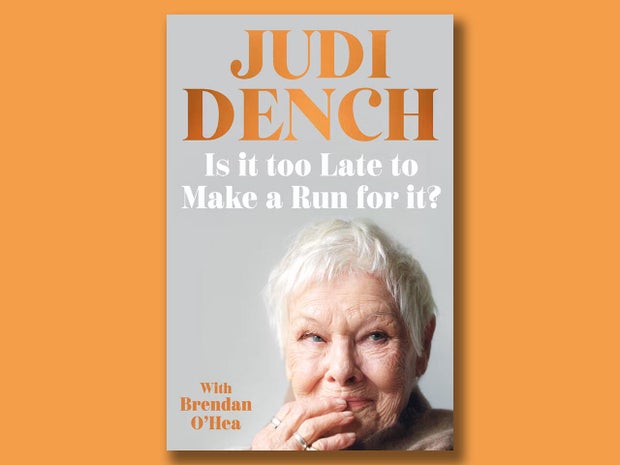
In her latest book, “Is It Too Late to Make a Run For It?” (published by St. Martin’s Press), Dench and O’Hea return with a collection of conversations revisiting an extraordinary career and a remarkable life, from Shakespeare to Bond.
Read the excerpt below – and don’t miss Seth Doane’s interview with Judi Dench and Brendan O’Hea on “CBS Sunday Morning” November 8!
Prefer to listen? Audible has a 30-day free trial available right now.
Choosing a Part
Have you always been in a position to choose which part you’re going to play?
Of course not. And it’s something I’ll never take for granted. Mikey used to say, ‘Always behave as if it’s the last job you’ll ever do.’ I still carry the fear of not working. Or of never being asked again. You can’t just expect to be employed in this business when there are so many terrific actors ready to step in.
I once knew an actor whose criteria for accepting a part depended on three questions: ‘What’s the billing? What’s the money? What’s the role?’ In that order. I’ve also known actors who’ve turned down jobs because their character didn’t say the last line of the play.
That’s ridiculous. You’d never play Hamlet or Lady Macbeth. Was it Michael Caine who said he judged a script by its location, and if he fancied going to the place where it was being filmed, he’d accept the job? I know what he means. That’s one of the reasons why I was so keen to do Mrs. Brown: a month in Scotland – bliss.
What are your own criteria for choosing a part?
I’m not very good at it, so I tend to leave it to others. When Mikey was alive, he would read any scripts I’d been sent and I’d totally trust his judgement.
I’ve never enjoyed reading scripts. I much prefer to be told the story – ideally by the director. When I met Stephen Frears to talk about the TV drama Going Gently, we went for a walk around Holland Park. It was lovely, being able to wander in the open air – no pressure, no expectations, nothing calculated – just listening to him tell me the story.
But some directors are more cunning – like Howard Davies, who came to the house to talk about Mother Courage and only told me the good bits. He didn’t tell me that Mother Courage is in every bloody scene and doesn’t shut up. I only found that out after the read-through. He also didn’t tell me that she pulls a massive cart around the stage all evening while her mute daughter (played by Zoë Wanamaker in our production) sits perched on top, says nothing, and then steals all the reviews. [Laughs.]
Why do you prefer to be told the story, rather than read a script?
Laziness, probably. Or maybe it’s the child in me, the memory of being read to when I was young. But I also think that when a director tells me the story it allows me to be more objective and I can imagine myself in the audience, experiencing it for the first time.
Is there a part of you that’s also assessing the director’s understanding of the story and how they’re planning to tell it?
Not consciously but, now you say it, yes, probably. You want to make sure you’re in safe hands, don’t you? That instinctive response to a script is so important (and vital to hold on to) because once you’ve committed, and rehearsals have started, it’s so easy to get lost in the weeds of a part. Holding on to that objective bird’s-eye view provides a reminder of the overall story, and also your place in that story. It’s a bit like being able to reference the picture on the front of a jigsaw box.
Somebody once said, ‘You can make a good script bad, but you can never make a bad script good.’
I think that’s true. That’s why it’s important to be alert to any little niggles when a director first tells you the story, because that’s when you can spot if something’s awry. Ultimately, you need to ask yourself: Is this story worth telling, and will it be arresting enough to make an audience sit and listen?
What’s interesting is you’ve not once talked about the size of the role.
Because for me, it’s the story that’s important, and asking myself if I want to be part of it. The other thing I like to know is who I’m going to be working with. I had such a good time being directed by John Madden on Mrs. Brown that I wrote to him afterwards and said, ‘If you have anything else up your sleeve – any old part, however small, even if it means just walking across the back of the shot – let me know.’ He wrote back, saying, ‘Well, funnily enough, I have got a small part which constitutes walking across the back of a shot,’ and that’s how I came to play Elizabeth I in Shakespeare in Love.
From “Is It Too Late to Make a Run For It?” by Judi Dench and Brendan O’Hea. Copyright © 2026 by the authors, and reprinted with permission of St. Martin’s Publishing Group.
Get the book here:
“Is It Too Late to Make a Run For It?” by Judi Dench with Brendan O’Hea
Buy locally from Bookshop.org
For more info:
- “Is It Too Late to Make a Run for It?” by Judi Dench with Brendan O’Hea (St. Martin’s Press), in Hardcover, Large Print, eBook and Audio formats