


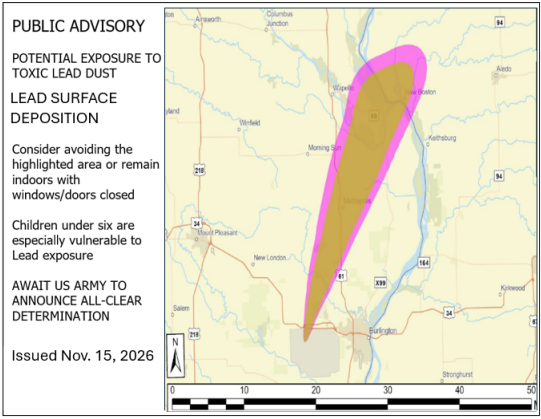
A plume of dust containing toxic lead particles is expected to spread across portions of eastern Iowa and northwest Illinois Friday, potentially settling on farmland, playgrounds and other surfaces, following a planned U.S. Army detonation of unstable explosives.
The detonation is scheduled for noon CT Friday, Nov. 20, at the Iowa Army Ammunition Plant in Middletown, Iowa, a small community of 360 people four hours west of Chicago near the Mississippi River.
The Army plans two controlled detonations involving 68 barrels of lead azide, a highly sensitive explosive used in military ammunition since World War I. The Associated Press reported the material totals about 5 tons. According to the Environmental Protection Agency, the material has deteriorated during storage, allowing lead azide to recrystallize and become increasingly sensitive to friction and shock.
The barrels had been stored at the plant for more than 20 years in earthen-covered containers, sitting in a bath of ethanol and water to keep the material stable, said Justine Barati, a public affairs specialist at Army Sustainment Command. A routine check earlier this year found that some of the water had evaporated, Barati told the AP.
The Army says moving or transporting the material now poses an unacceptable risk of accidentally detonating it, potentially even killing the explosives technicians handling it. After evaluating alternative disposal methods, military officials determined that detonating the explosives in place was the safest available option. Barati said the risk of accidental detonation increases in cold weather. “We’re really concerned that it will detonate on its own,” she told the AP. The Army describes such operations near populated communities as highly uncommon, it told CBS News Chicago.
The Army says it is taking several steps to limit the amount of lead-containing dust released during the explosions, including earthworks, soil wetting and air monitoring. According to the AP, the barrels are surrounded by concrete and buried under soil, with sand barriers stacked two stories high around them. Barati said the soil will be sprayed with water and the air misted to try to keep the majority of the lead on Army property. EPA’s permit also requires environmental monitoring at the installation and off-site locations, along with post-detonation sampling and cleanup measures.
Residents urged to evacuate as explosions could shatter windows
The planned detonations are powerful enough that the Army is warning of possible damage to nearby buildings, including shattered windows. Residents in Middletown’s City Park neighborhood are being asked to temporarily evacuate their homes from 8 a.m. to 2 p.m. Friday. Residents who can’t leave should stay inside with windows and doors closed, officials said.
In its Nov. 15 public advisory, the Army says residents should expect loud explosions, ground vibrations and a visible dust plume. Temporary accommodations will be available at the Armed Forces Reserve Center in Middletown.
Toxic lead dust could travel miles downwind
Following the initial blast, airborne toxic dust becomes the main concern. According to the Army’s published plume forecasts and public safety advisory, the explosions are expected to release particles containing lead into the atmosphere.
The preliminary maps show a potential airborne plume stretching northward across eastern Iowa, the Mississippi River, and potentially into far northwest Illinois. The Army notified communities as far as 100 miles away Sunday, the AP reported, and thousands of people live along the plume’s projected track.
In addition to airborne dust, toxic dust particles are expected to settle on surfaces. That raises concerns about possible lead contamination on agricultural land, residential properties, playground equipment and other outdoor surfaces.
Actual exposure levels and the extent of any contamination will depend on the amount of lead released, atmospheric conditions and how much material settles out of the plume.
Lead is a toxic heavy metal that does not degrade naturally over time. Once deposited, it can persist in soil for decades and may be transported through erosion or runoff into waterways.
The Centers for Disease Control and Prevention warns that no safe blood lead level has been identified in children. Even relatively low levels of lead in the blood have been linked to learning difficulties, developmental delays and behavioral problems. Lead exposure is also especially dangerous to pregnant women.
Patrick O’Shaughnessy, a professor at the University of Iowa’s Department of Occupational and Environmental Health, told the AP it is encouraging that the Army and EPA are working to minimize the dust, but it’s still unknown how much will end up in the air and on surfaces. He said he is particularly concerned about toddlers who put everything in their mouths. Andrew Whelton, an environmental engineering professor at Purdue University who has helped communities recover from chemical disasters, told the AP that high doses over a short period can cause lead poisoning and make people feel sick.
The Army’s forecasts do not establish that harmful exposure will occur at every location within the projected plume. The Army says extensive modeling predicted that lead particle levels in the air may be elevated but still well below the level at which the EPA would require protective action, according to the AP. Environmental sampling will be needed to determine where lead was deposited and at what concentrations.
Weather conditions will determine where the plume travels
Wind direction, speed and vertical motion in the atmosphere will play critical roles in determining the plume’s eventual path. Officials expect the dust to linger for no more than an hour, depending on wind speed, according to the AP.
Current forecast guidance suggests gusty southerly winds of 20 to 30 miles per hour Friday will carry the plume northward through eastern Iowa, keeping it well west of the Chicago metropolitan area. Communities closer to the Mississippi River and the Illinois border could be more relevant to potential downwind exposure. The exact path remains subject to change as the detonation approaches.
Under the EPA’s emergency permit, the operation cannot proceed if certain unfavorable weather conditions are forecast, including surface winds below 1 mph or above 15 mph, strong winds aloft, thunderstorms, precipitation or temperature inversions. There is no word yet on whether Friday’s gusty winds could cancel the detonation.
The Army is required to update its plume forecasts six hours before the operation, and hourly thereafter until the detonations are completed.
Army promises environmental monitoring and cleanup
The permit requires soil and surface-wipe sampling to begin within 24 hours in accessible public and consenting private areas where modeled lead-dust deposition meets a specified threshold. The Army must also submit environmental findings and proposed remediation plans to EPA.
For residents potentially affected by dust deposition, the Army recommends wet-cleaning surfaces that people frequently touch, including outdoor toys, playground equipment, patio furniture and windowsills. However, questions remain about the extent of contamination that could occur beyond the ammunition plant, the effectiveness of cleanup efforts and how residents will know whether their properties are safe.
EPA issues emergency permit for detonation
On Nov. 13, the EPA issued an emergency permit allowing the Army to detonate the lead azide at a location not authorized for the activity under the facility’s existing hazardous-waste permit. In its Nov. 16 public notice, EPA said the emergency authorization was necessary to address an imminent threat to public safety posed by the unstable explosives.
The detonation is being regulated under the federal Resource Conservation and Recovery Act, or RCRA, which governs the treatment, storage and disposal of hazardous waste. However, federal emergency-permitting provisions allow greater flexibility than ordinary permitting procedures. Under 40 CFR § 270.61, applicable environmental requirements must be incorporated into emergency permits to the extent possible and consistent with the emergency situation.
The emergency permit issued for Middletown includes specific environmental safeguards and incorporates applicable federal hazardous-waste regulations. It remains unclear whether EPA modified or omitted any requirements that would ordinarily apply to this operation because of its emergency designation.
The EPA’s authorization does not mean the detonation will produce no environmental contamination.
CBS News Chicago has sought additional information about the EPA’s environmental risk assessment and the standards that would trigger cleanup of affected properties.
The Illinois Department of Public Health referred CBS News Chicago’s questions about potential health impacts back to the EPA. Environmental and public health officials in Illinois have urged the military to conduct comprehensive sampling in that state after the detonations, the AP reported.
Iowa Health and Human Services told CBS News Chicago it was made aware of the planned detonation only very recently and is coordinating with other state agencies as they assess and respond to the public health concerns. The agency said the Army released two maps showing possible exposure but did not say what conditions the modeling included.
Community concerns grow ahead of Friday
Some residents and environmental advocates are questioning whether the planned detonation has received sufficient independent scrutiny. Protest organizers have called for greater transparency, independent environmental review and assurances that any contamination resulting from the explosions will be properly addressed.
U.S. Sen.-elect Josh Turek was among those calling for the detonation to be delayed, arguing the public needs a better understanding of the potential health impacts, the AP reported.
Middletown residents learned in March that the Army needed to dispose of the degraded lead azide, after the plant paused operations for a review and the material was discovered, the AP reported. The Army previously held a public open house on Oct. 15, where military officials discussed the safety operation and answered residents’ questions.
Some schools in the region are canceling classes Friday, including in Danville, a few miles from the plant. Superintendent Pat Wallace said his initial intention was to keep schools open, but the uncertainties made closing “the most responsible decision.” He wrote that he is not suggesting the detonation will create unsafe conditions: “The reality is that we simply do not know exactly what conditions will look like Friday afternoon,” the AP reported.
In Mediapolis, less than 20 miles northeast of the plant, city officials learned of their potential exposure Sunday, when the Army’s map put the town in the center of the dust exposure area, the AP reported. The school district announced Tuesday it will close Friday with no events or sports practices, and the public library will also close. The local fire department plans to hose down playgrounds that could be covered in lead particles. City officials said the EPA will have a command center in Mediapolis to sample air, soil and water during and after the detonation, and the city plans to do its own testing.
“The biggest issue we’re having is the lack of information,” Deputy City Clerk Amy Stucker told the AP. Iowa Gov. Kim Reynolds’ office said it was first briefed on the public advisory Monday.
The Iowa Department of Agriculture advised bringing animals, bales of hay and water indoors. Staff at the Iowa State University Extension office in Des Moines County fielded calls Thursday from residents “deathly afraid” for their animals and vegetable gardens, staff member Morgan Hoenig told the AP. “We ran out of soil test kits yesterday,” she said.
The Army recommends that those within the projected exposure area consider avoiding outdoor activities, remaining indoors with windows closed and setting ventilation systems to recirculate air until officials announce that the exposure period has ended.
The latest official plume forecasts, public advisories and safety instructions are available on the U.S. Army’s Iowa Army Ammunition Plant information page.
Residents can sign up for toxic plume forecast updates from the U.S. Army by sending an email request with the subject line “IAAAP Environmental Updates” to [email protected].