



Award-winning actor Tony Shalhoub’s new book, “We Thought They’d Never Leave: Musings on Food and Family” (written with Josie Adams, and published by Gallery Books), offers reflections on the role of food in his family reunions, along with recipes. He offers “Sunday Morning” viewers a story about a traditional bread – and tips on how to make it:
Although this Middle Eastern staple is commonly called “manakeesh” or “za’atar bread,” as kids, we always referred to it as “dirty bread.” That moniker grew out of exactly how it looked to us, smeared with a dark, gritty, bespeckled oily coating. We loved homemade flatbread that was warm and soft, cool and crispy, drizzled with honey, spread with jam, dipped in labneh, or drenched in honey and jam and labneh. We also loved it wrapped around fresh greens or rolled into a cone and filled with hummus or Greek olives. What we could not understand was why the adults would take a perfectly perfect piece of flatbread and slather it with this slightly tart, slightly bitter, slightly grainy, super pungent “topsoil.” To us, this was not so much gilding the lily as it was graveling the lily. My mother’s soothing assurances that it was an “acquired taste” were always greeted with a collective eye roll. Yeah, right. …
And then, one day … it just happened! One by one, as each of us reached a certain age or a certain stage—or a certain level of hunger—the penny dropped. Maybe it was the only snack within reach. Maybe it started with a dare. Whatever the reason, we tried it, understood it, and from then on suddenly we just had to have it.
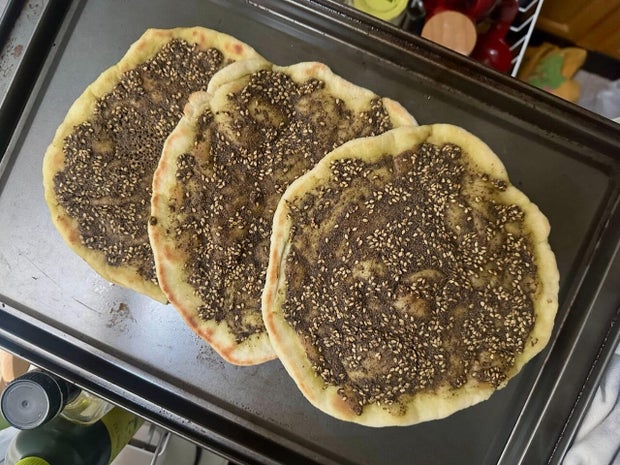
Dirty Bread (Manakeesh)
by Tony Shalhoub
Makes three 9-inch round flatbreads
Ingredients:
For the dough
- ½ cup warm water (about 110°F)
- 1 tablespoon unsalted butter, softened
- 1 ½ cups plus 1 tablespoon bread flour, plus more for dusting
- 1 tablespoon extra-virgin olive oil, plus more for the bowl
- 1 teaspoon sugar
- ½ teaspoon instant or active dry yeast
- ½ teaspoon coarse kosher salt
For the topping
- ¼ cup za’atar
- 4 to 6 tablespoons extra-virgin olive oil, as needed
Directions:
Make the dough: In a small bowl, whisk together the warm water, butter, 1 tablespoon of the flour, the olive oil, sugar, yeast, and salt until everything is dissolved (with instant yeast you can move on right away; with active dry you may need to let it sit for 10 to 15 minutes until it starts to foam).
In a stand mixer fitted with a dough hook, or a medium bowl if mixing by hand, combine 1 cup of the flour and the liquid mixture. Mixing on medium-low speed, or by hand, knead until a shaggy dough forms. Continue kneading, scraping the bowl as needed and adding as much of the remaining . cup flour as necessary (you might not need all of it) until the dough is smooth and no longer tacky or sticks to the bowl, 2 to 3 minutes total by machine and 4 to 5 minutes by hand.
Turn out the dough onto a clean work surface and knead a few times, then shape it into a ball. Grease a clean large bowl with olive oil, then add the dough and cover with a kitchen towel. Let rise until doubled in size, about 1 hour (or longer if your kitchen is cold).
Put an upside-down baking sheet (or a baking stone if you’ve got one) on the middle rack of the oven. Preheat the oven to 500°F.
Turn out the dough again and cut it into 3 equal pieces. Lightly dust your surface with flour and, working 1 dough ball at a time, use a rolling pin to roll the dough into a circle about 9 inches wide. Dust the dough with flour and flip it over often to prevent it from sticking. If the dough is shrinking after you roll it, let it rest for 5 minutes and try again. (At this point the dough can be separated with layers of parchment paper between to prevent sticking, placed in a zip-top bag, and frozen for up to 1 month. Let thaw at room temperature, then bake as directed below.)
Once all the dough is rolled out, carefully pull the middle rack slightly out of the oven and put the dough rounds on the preheated baking sheet without overlapping (work in batches if you need to). Bake for 3 to 4 minutes total, using a spatula or tongs to flip once, until just cooked through and golden in spots on both sides. Remove the flatbreads from the oven and keep the oven on with the baking sheet inside.
Make the topping: In a small bowl, stir together the za’atar and 4 tablespoons of the olive oil until it’s a spreadable paste. You may need to add more of the remaining 2 tablespoons of oil to thin it, but you don’t want it so runny the oil will drip off the sides (and all over your oven).
Brush the tops of the bread rounds with the paste, covering them edge to edge. Return them to the oven and bake for 1 to 2 minutes, until the za’atar is sizzling on top and the edges are starting to crisp. Slice and serve warm.
Feed a Crowd
Plan on 1 flatbread for every two or three people (depending on whatever else you’re serving). Multiply the quantities as needed, but in a standard home mixer, you’ll probably only be able to mix 2 batches at once. Bake all of the flatbreads before brushing them with the za’atar mixture and serve them warm as they come out of the oven.
Excerpted from “We Thought They’d Never Leave” by Tony Shalboub with Josie Adams. Copyright © 2026. Reprinted by permission of Gallery Books, a division of Simon & Schuster, Inc.
For more info:
- “We Thought They’d Never Leave: Musings on Food and Family” by Tony Shalhoub with Josie Adams (Gallery Books), in Hardcover, eBook and Audio formats, available via Amazon, Barnes & Noble and Bookshop.org
Check out more recipes from the “Sunday Morning” 2026 Food Issue Recipe Index!