


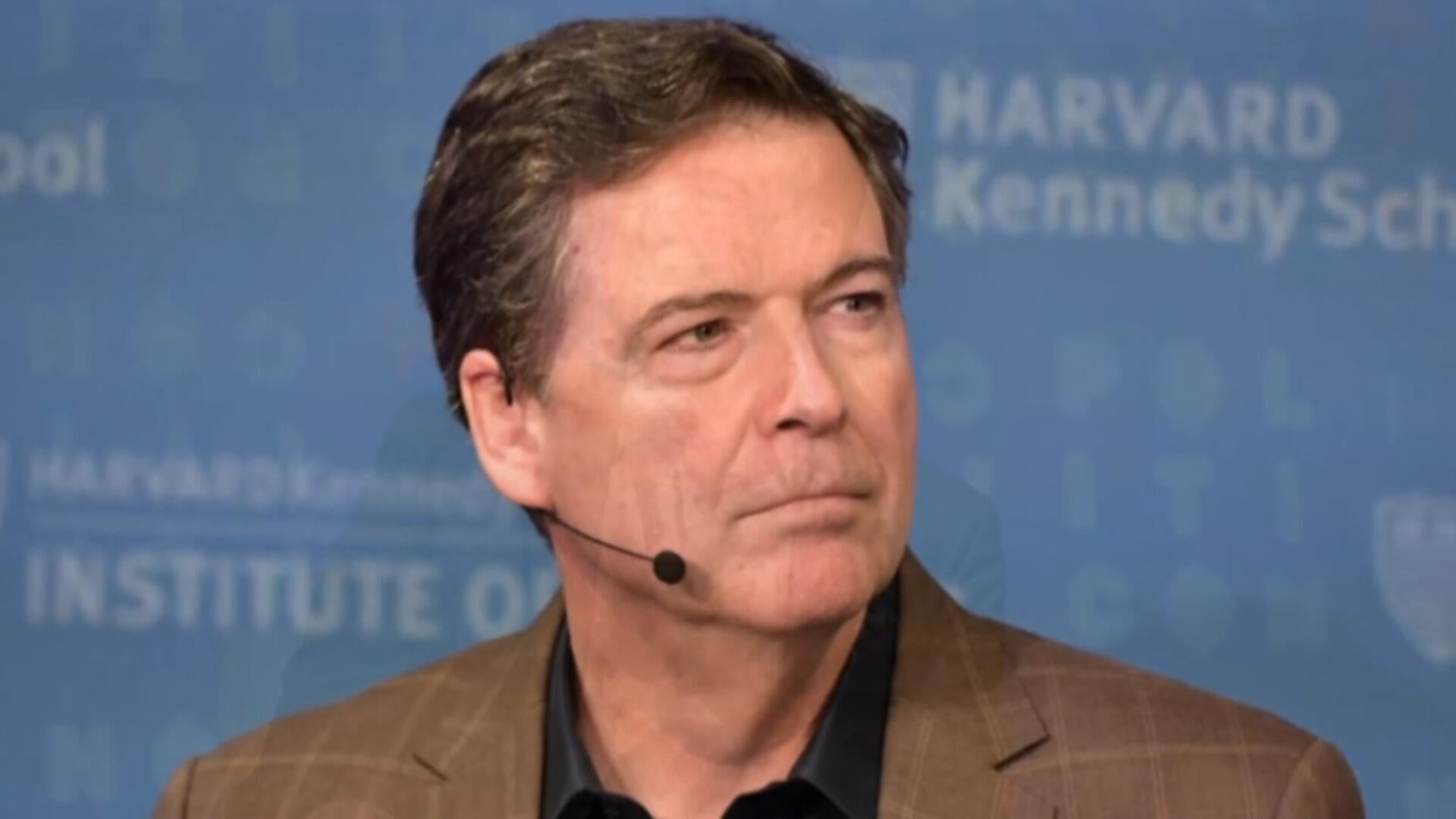
▶ Watch Video: DOJ trying to charge Trump-foe James Comey for third time, records show
The Justice Department took steps to charge James Comey with leaking classified information earlier this month, court records show, in its third attempt to bring criminal charges against the former FBI director and Trump foe.
Prosecutors are seeking to charge Comey with two counts of violating the Espionage Act by transmitting national defense information to a person not entitled to receive it. He has not been indicted by a grand jury or charged by criminal complaint, and was instead targeted through a criminal information filing.
In this case, the information was filed in order to preserve the statute of limitations before it expires, according to a Justice Department spokesperson. The official added that “this is an ongoing criminal investigation, and we will not comment further.”
A criminal information does not require approval by a grand jury, or a finding by a magistrate judge of probable cause that there is evidence to establish that a crime was committed.
Comey’s attorney, Patrick Fitzgerald, said Comey “steadfastly maintains his innocence.”
The latest effort by the Justice Department stems from allegations that Comey gave national defense information to an unnamed individual for disclosure in a newspaper in October 2016.
According to court filings in the case, The New York Times published an article on Oct. 5, 2016, titled, “Yahoo Said to Have Aided U.S. Email Surveillance By Adapting Spam Filter.” The article cited two unnamed government officials who spoke on the condition of anonymity.
The Justice Department alleges that it has uncovered evidence that Comey sought to “correct misinformation which had appeared in the press by way of Reuters the day before” and that Comey “directed staff” to speak with the Times reporter about the accuracy of the Reuters article.
Fitzgerald said the information “purports to charge Mr. Comey with crimes that he did not commit,” adding that investigators looked into the matter twice during the first Trump administration and “determined that no charges should be brought against anyone.”
In a separate video statement, Comey said, “well, they’re back again” — a reference to the two prior attempts to charge Comey, including a dismissed indictment accusing him of lying to Congress and a still-pending indictment accusing him of threatening President Trump via a social media post of a photo of seashells arranged to say “86 47.”
“It would almost be funny if it weren’t such an appalling abuse of the Department of Justice, one that we cannot become numb to,” Comey said. “Nothing’s changed with me. I’m still innocent, I’m still not afraid of these people and I still believe in the independent federal judiciary.”
In a statement posted to social media, the Justice Department said: “Filing a criminal information to toll the statute of limitations is a widely recognized practice in federal court and has been approved by multiple Circuit Courts of Appeals.”
Former prosecutors and defense attorneys told CBS News they had not seen a criminal information filed in a felony case in this manner before, and called the maneuver highly unusual.
Michael Bromwich, a former Justice Department inspector general who is now a defense attorney, told CBS News that he has never encountered a situation where a criminal information was filed to pause the statute of limitations. Normally, such charging documents are filed when a defendant plans to waive their right to have a grand jury weigh charges and opts to plead guilty.
“I have never heard of proceeding by information to toll the statute of limitations. Most prosecutors you have ever dealt with have never heard of that. This seems to be a way to do an end-run around the statute of limitations and keep a case alive that deserved to die 9 years ago,” Bromwich said. “This is just absolutely bizarro world stuff.”
DOJ and Comey fought in secret over charging efforts
The charging documents were filed under seal in early October, and were unsealed by U.S. District Judge Trevor McFadden on Monday at Comey’s request.
For much of this month, Comey’s attorneys and federal prosecutors waged a behind-the-scenes fight over whether the Justice Department’s effort to charge him should be dismissed.
In an Oct. 9 court filing, Comey’s legal team argued the government “filed a faulty information under seal … in an effort to toll the applicable statute of limitations.” The crime that the government is seeking to charge Comey under has a 10-year statute of limitations, which would run out in October of this year — but the ex-FBI director’s lawyers say the statute of limitations applies to indictments and can’t be extended if the government files a criminal information.
They also said Comey had “reason to believe that the government plans to use that information to seek an arrest warrant as soon as today, which could result in an after-hours arrest that would ensure Mr. Comey sits in jail over a holiday weekend.”
“Mr. Comey has reason to believe multiple federal law enforcement officers have surveilled his whereabouts while traveling to a family members’ residence and around his own neighborhood throughout the week,” Comey’s lawyers wrote on Oct. 9, just before Columbus Day weekend.
In an emergency court hearing, the government agreed to hold off on seeking an indictment for 30 days, attorneys for Comey later wrote.
The Justice Department argued that Comey’s efforts to dismiss the criminal information was premature because no indictment has been returned.
“This is not the proper time for him to file pretrial motions or attempt to chip away at charging documents before he subjects himself to the Court’s jurisdiction,” the government said.
Further, the department said the law allows the government to proceed because it permits prosecutors to meet the deadline if the “indictment is found or the information is instituted.”
In an unusual move, the criminal information filed by the department were signed by two senior officials — acting Deputy Attorney General Trent McCotter and Principal Associate Deputy Attorney General Aakash Singh — as well as several special assistant U.S. attorneys who are not originally from the U.S. Attorney’s office in Washington, D.C.
McFadden, the Trump-nominated judge overseeing the case, ordered the court docket to be unsealed Monday, writing: “Criminal charges against a former FBI director for his conduct while in office are of significant public interest.”
He also said Comey “is aware of the criminal information and has offered to ‘self-surrender,'” so there is no need to keep the case secret in order to help the government apprehend him.
The judge did not rule on the merits of the case.
Two prior investigations into FBI leaks
This is not the first time that the Justice Department has sought to investigate the disclosure of classified information in connection with a 2016 Times article.
Former U.S. Attorney John Durham of Connecticut, who was later appointed special counsel by Attorney General William Barr, investigated the matter in 2017, according to court filings in the case from Comey’s defense team. At the time, he determined there were two sources for the article, including James Baker, the former FBI general counsel.
As part of that investigation, Baker said the FBI’s chief of staff instructed him to provide the information and he understood it was being conveyed at Comey’s instruction.
Durham ultimately did not recommend Baker or anyone else for prosecution.
Baker could not be immediately reached for comment.
The matter was later investigated a second time — in that case by the U.S. Attorney’s Office for the District of Columbia under an investigation code-named Tropic Vortex. That was closed in February 2020, also without charges, according to court papers.
Comey and Trump
The Justice Department filed the criminal information in early October, about a month before the midterm elections. It marks the latest overt investigative step taken by the Justice Department in a politically charged case, a maneuver that runs counter to longstanding norms.
Mr. Trump and Comey have had a contentious relationship for nearly a decade, dating back to when the president fired the former FBI chief early in his first term. His firing is what prompted then-Deputy Attorney General Rod Rosenstein to appoint Special Counsel Robert Mueller, whose investigation dogged Mr. Trump for much of his first term.
The two have exchanged barbs since then, with Mr. Trump calling Comey a “dirty cop” and repeatedly arguing he should be prosecuted, while Comey called Mr. Trump “morally unfit” to be president.
In September 2025, the Justice Department obtained an indictment against Comey that charged him with lying to Congress, alleging he falsely told lawmakers in a 2020 hearing that he had never authorized an FBI employee to serve as an anonymous source.
The indictment was personally signed by Lindsey Halligan, a former Trump White House aide who had been sworn in as interim U.S. attorney for the Eastern District of Virginia days earlier. Beforehand, staff in that office circulated a memo that argued charges should not be brought against Comey, CBS News has previously reported.
A judge dismissed the charges on the grounds that Halligan was improperly appointed.
Then, in April of this year, Comey was indicted in North Carolina on allegations that he threatened to kill Mr. Trump by posting to Instagram a photo of seashells arranged to form the numbers “86 47.” (Mr. Trump is the 47th president.)
Comey has long denied wrongdoing, and his attorneys have argued the charges against him are politically motivated. They are currently seeking to have the North Carolina charges dismissed on several grounds, including that his prosecution is vindictive and selective. That matter is currently pending.
Comey isn’t the only Trump foe to face criminal scrutiny. New York Attorney General Letitia James was also charged by Halligan’s office with bank fraud last year. Her indictment was tossed out along with the first Comey indictment. Prosecutors presented her case to grand juries at least twice after that, but the grand jurors declined to re-indict her.
Attorney General Todd Blanche has long denied that the charges against Comey and other Trump adversaries are driven by politics. In an interview with CBS News earlier this year, he said the “86 47” indictment was driven by “local prosecutors” and “local agents.”
Asked if Mr. Trump has called him up and ordered him to prosecute certain individuals, Blanche told CBS News he wouldn’t discuss his conversations with the president, but “rest assured, he has much better, bigger and important things to do than to worry about me doing my job.”